 Hard Hat Way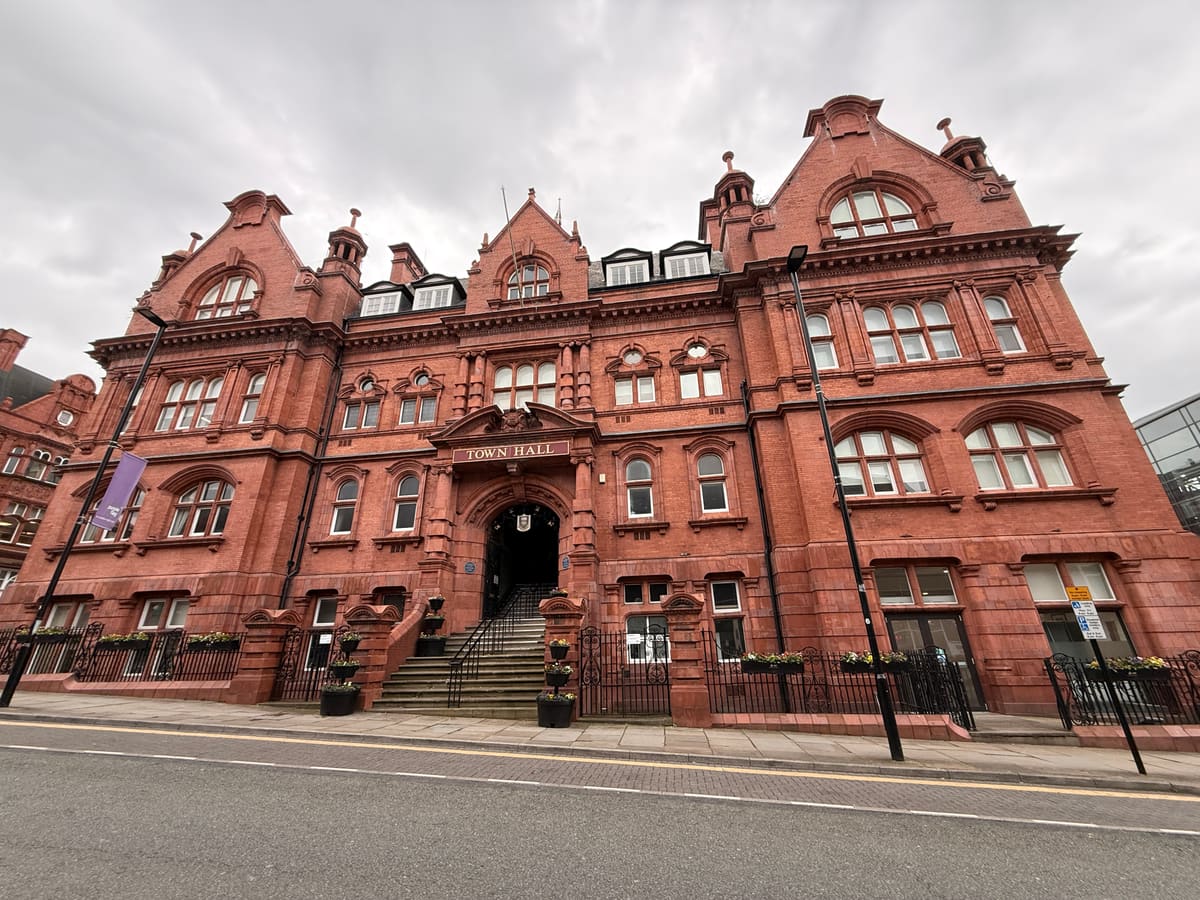
#LookUpHistory · Library Street, Wigan
The old Mining & Technical College
The old Mining & Technical College, Library Street, Wigan
You've probably walked past it a thousand times. Nipped into town, crossed Library Street, maybe stopped for a brew somewhere nearby — and never once actually looked up.
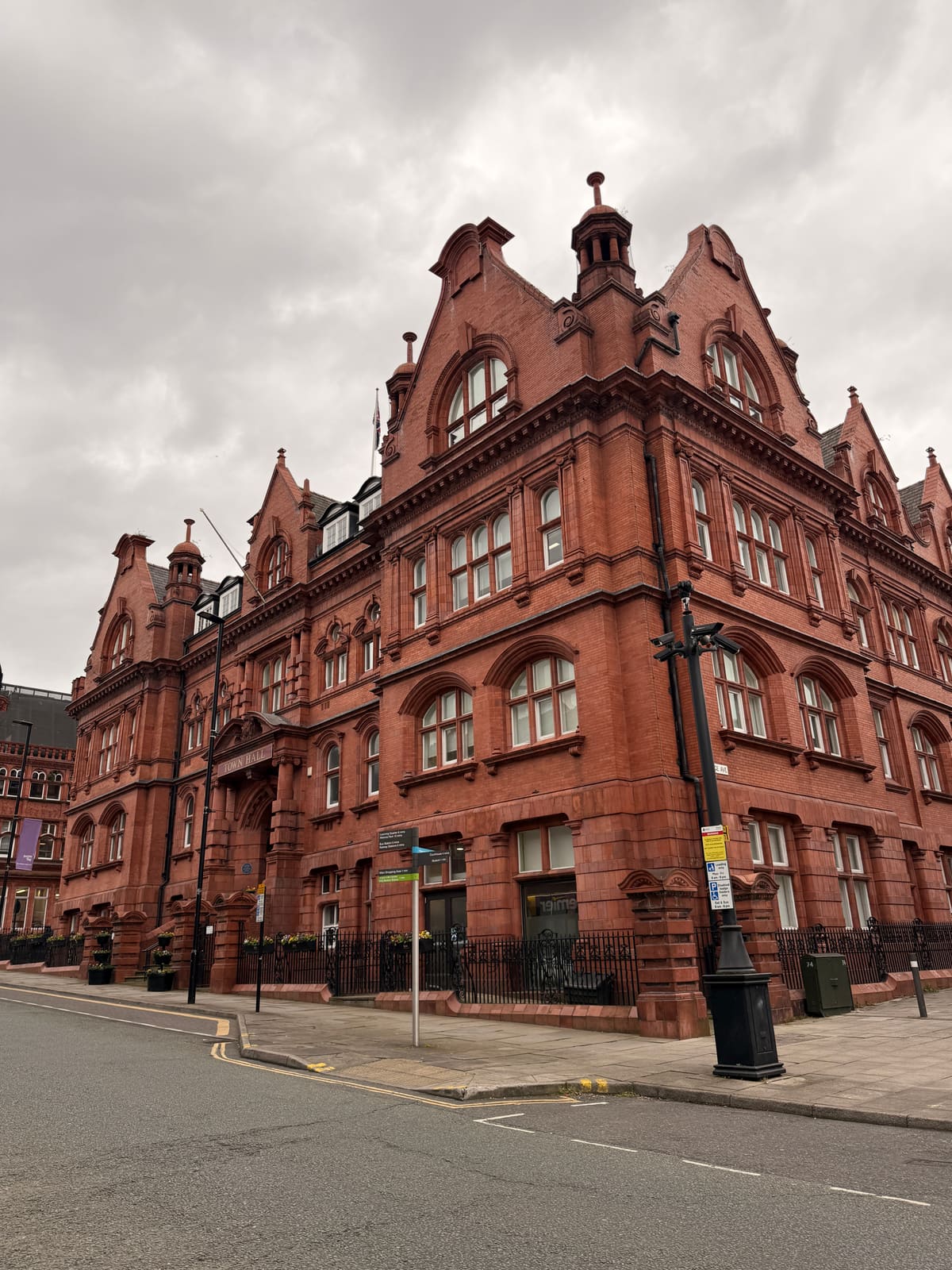
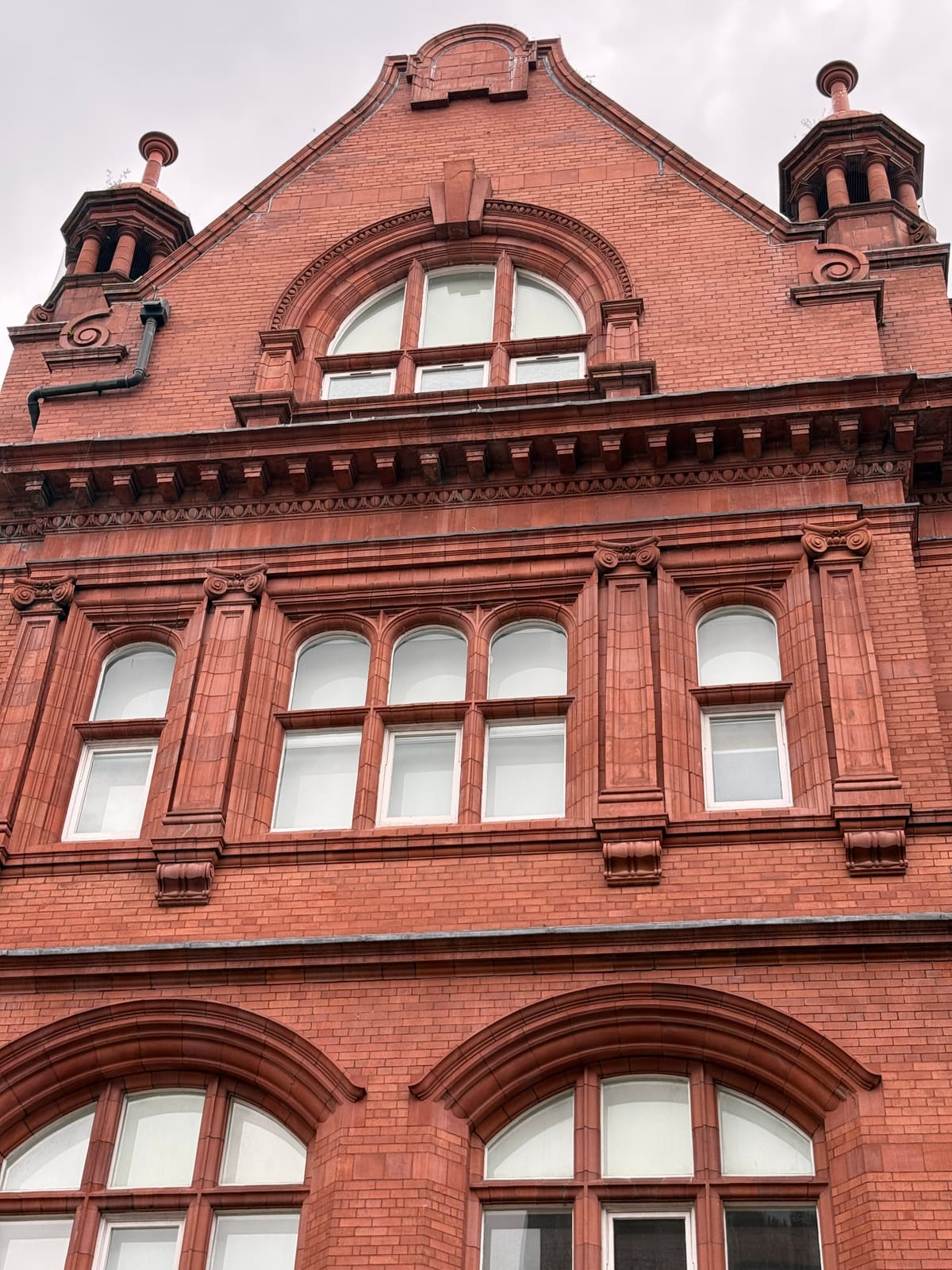
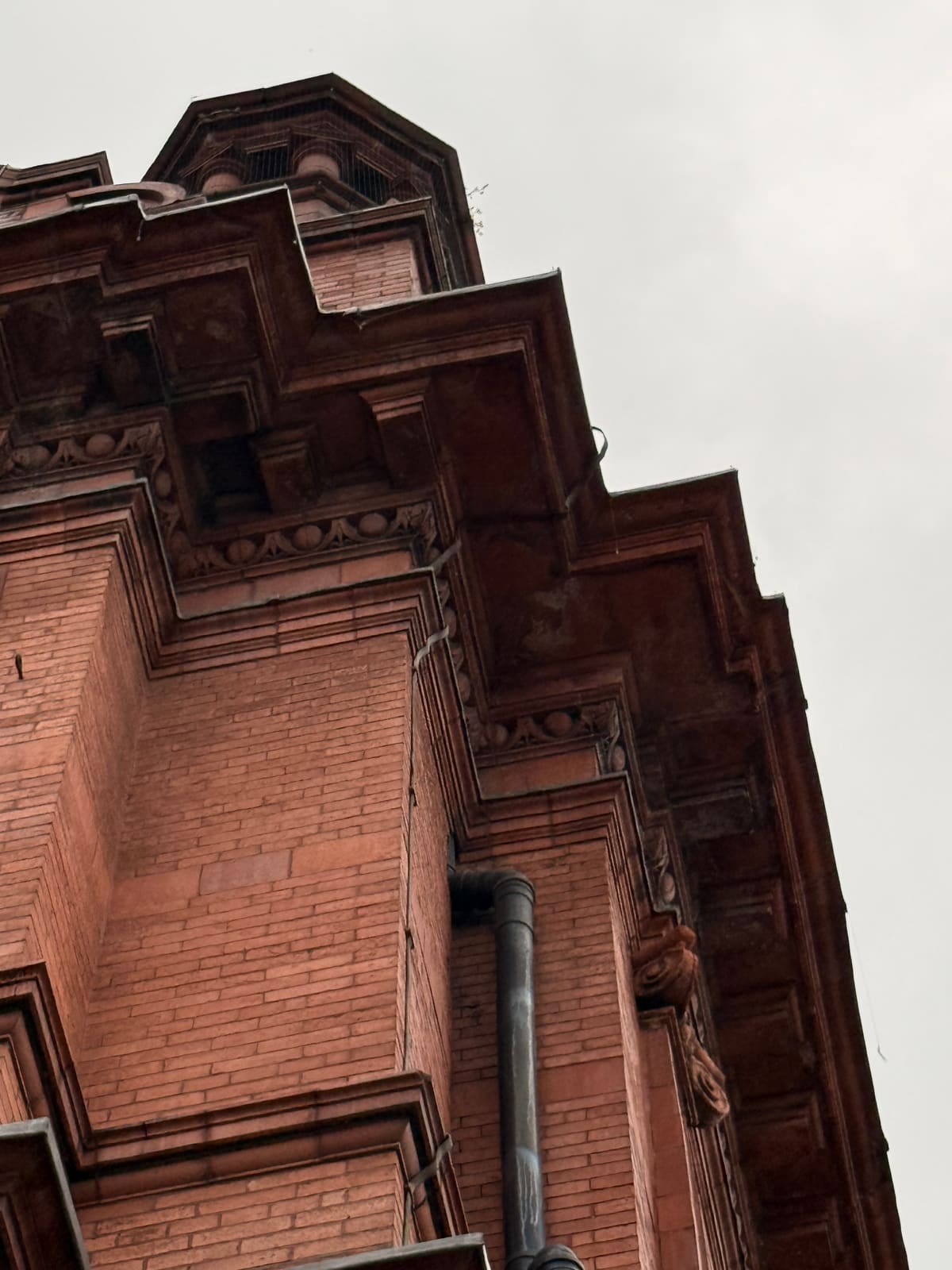
Do it. Stop for two minutes. Lift your head. Because what's stood in front of you is one of the finest Edwardian Baroque facades anywhere in the North West of England. Red brick, deep red terracotta glowing in whatever weak Wigan sunlight we've been given that day, Ionic columns flanking the entrance, gabled attics stepping up to the sky, cupolas perched on every corner. A four-storey monument to the industry that built this town — and to the men who trained to run it.
This is Wigan Town Hall. But here's the first thing that'll throw you: it wasn't built as a town hall. Not even close.
It was built to train miners
What you're looking at started life in 1900 as the Wigan Mining and Technical College — a serious, purpose-built training ground for the mining engineers, surveyors, and tradesmen who kept the Lancashire coalfield running.
And you have to picture what Wigan was back then. In the 1840s there were over 1,000 pit shafts within a five-mile radius of this very spot. A thousand. Every direction you looked, there was a pit-head winding gear chucking coal up out of the ground. This town was coal. And this building was its brain.
The foundation stone was laid by the Countess of Crawford on 11th July 1900. The contract went to Joshua Henshaw and Sons of Liverpool. Two and a half years later, on 12th January 1903, the Countess came back to officially open it — at seven o'clock at night, so the student prizes could be handed out straight after. An awning was put up over the main entrance on Library Street, lit with electric lamp bulbs specially supplied by Wigan Corporation — proper cutting-edge stuff for 1903. You can imagine the crowd on the pavement, the gas lamps, the horses, the whole town turned out to see what had landed on their doorstep.
The architects were serious operators
The job was given to Briggs and Wolstenholme of Liverpool and Blackburn — and this is important, because people assume a provincial building must have been done by some local lad with a drawing board. Nothing of the sort.
The same year they landed this job, Briggs and Wolstenholme won first premium in the competition to design the Liverpool Dock Offices — one of the famous Three Graces on the Liverpool waterfront. So the firm building Wigan's college were, at that exact moment, designing one of the most iconic waterfronts in Britain. You're looking at the same hand, the same ambition, the same theatrical Edwardian Baroque swagger — just pointed at Library Street instead of the Mersey.
Pevsner, the great architectural historian, described it as "high and gabled, of red brick and red terra cotta with Edwardian motifs such as the alternately blocked columns." Translation from Pevsner-speak into proper English: dramatic, theatrical, and built to make your jaw drop. Which it does.
Now, properly look at it
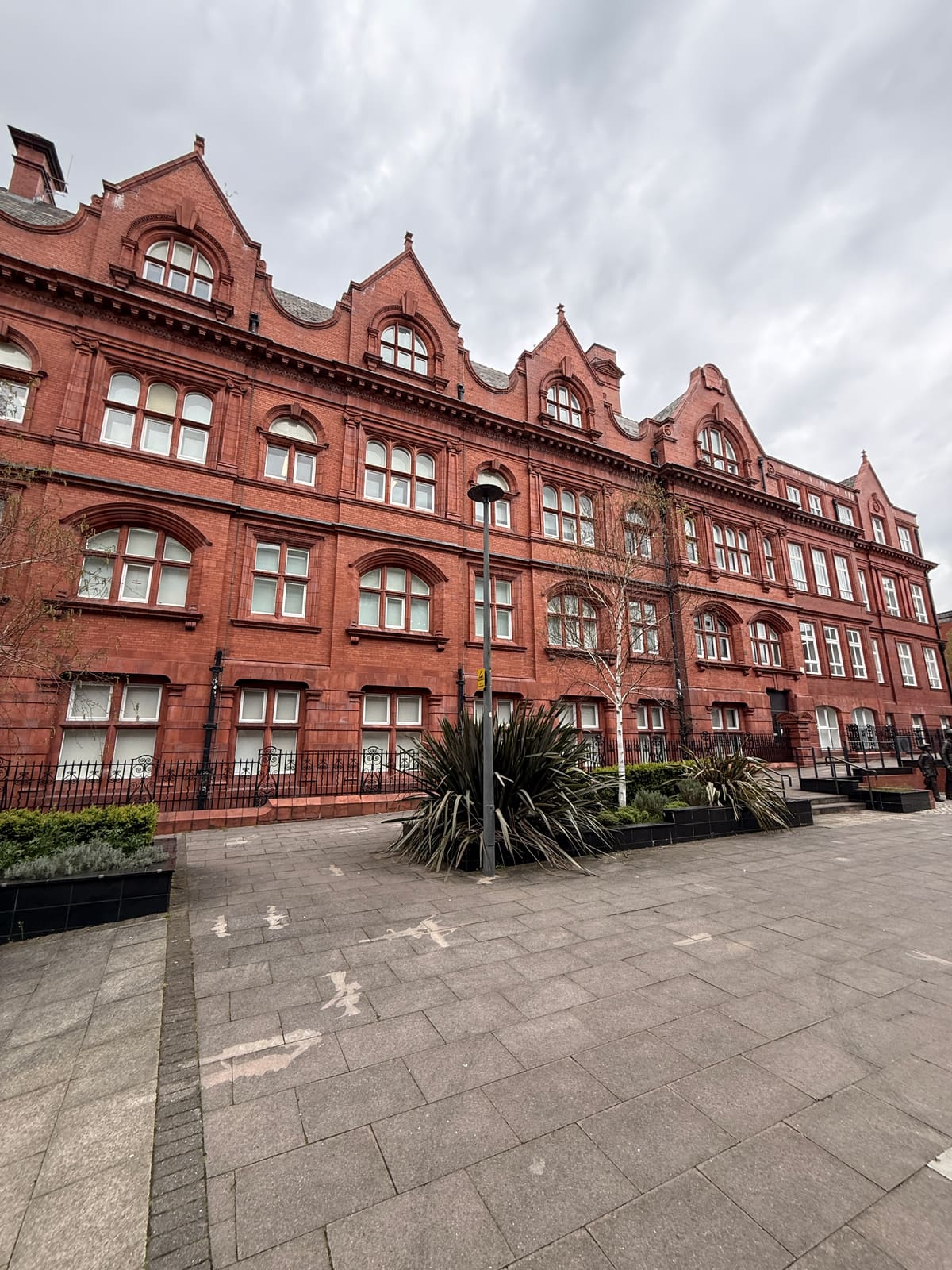
Stand on the pavement opposite and start at the top. Count the four corner turrets with cupolas — those little onion-topped towers on each corner. They're not decoration bolted on at the end; they were part of the original 1900 design, and they're what give the skyline its signature silhouette. You see one of those cupolas from across town, you know exactly what building it belongs to.
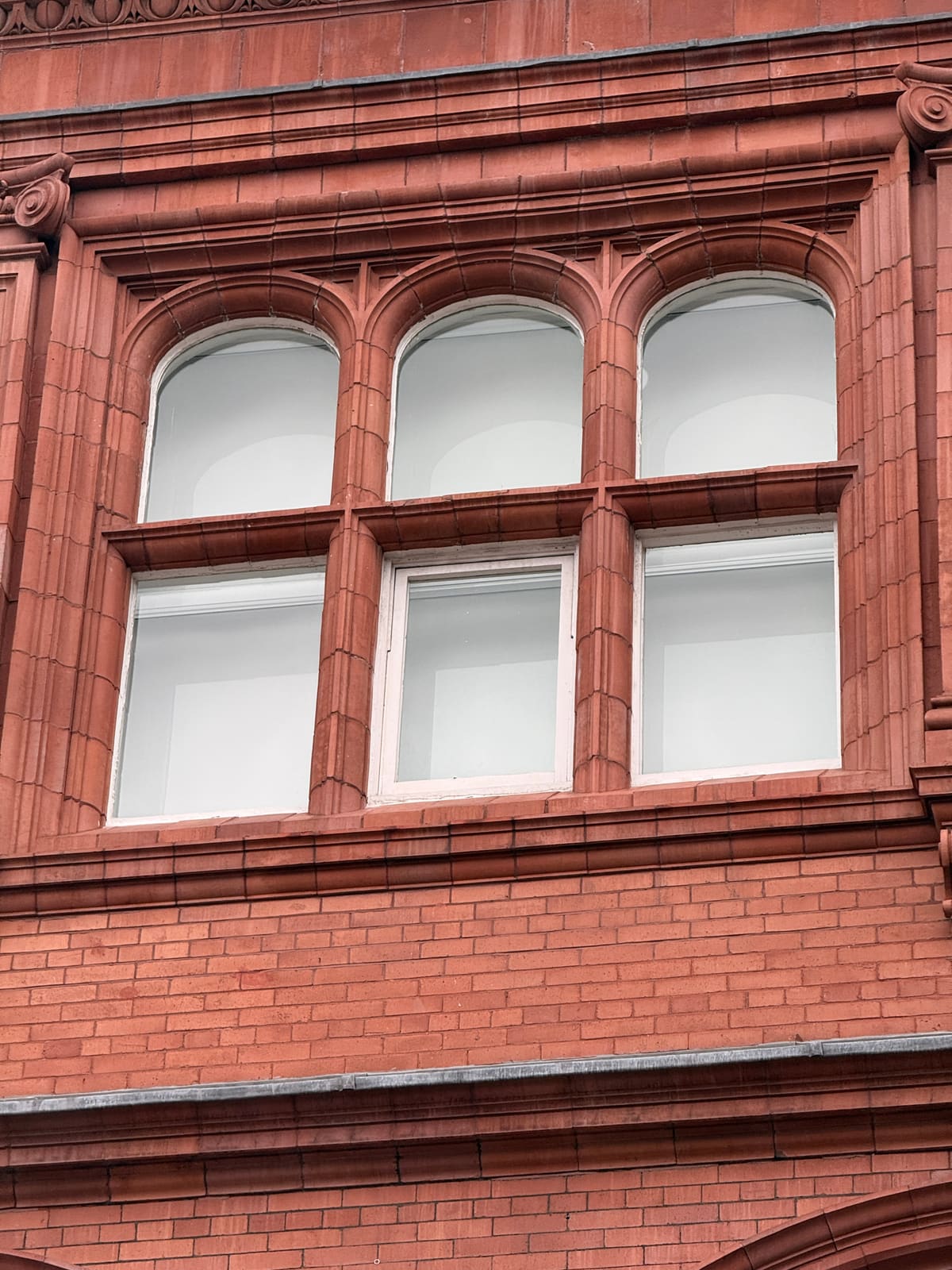
Drop your eye down. See those stepped, gabled attic windows with the arched tops? Pure Baroque theatre. Each one is its own little stage set, framed by terracotta scrolls and pediments.
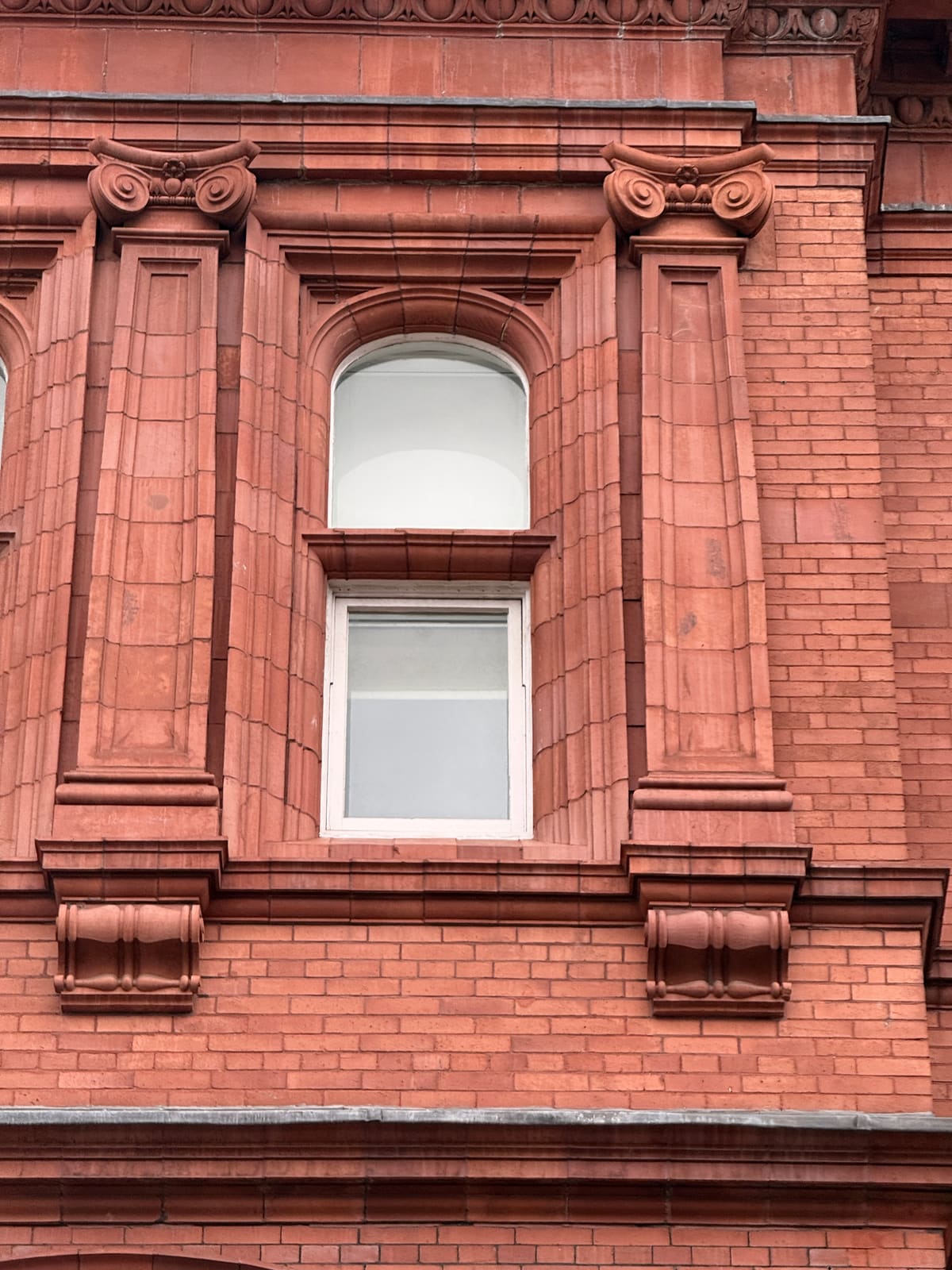
Drop down again to the main body of the facade. Those columns flanking the windows aren't just columns — look at the capitals at the top. Ionic scrolls, beautifully modelled, like ram's horns unfurling. And the columns themselves are what Pevsner called "alternately blocked" — meaning they've got rectangular chunky blocks breaking up the smooth shaft at intervals. It's an Edwardian flourish, it's unusual, and it's pure showing-off.
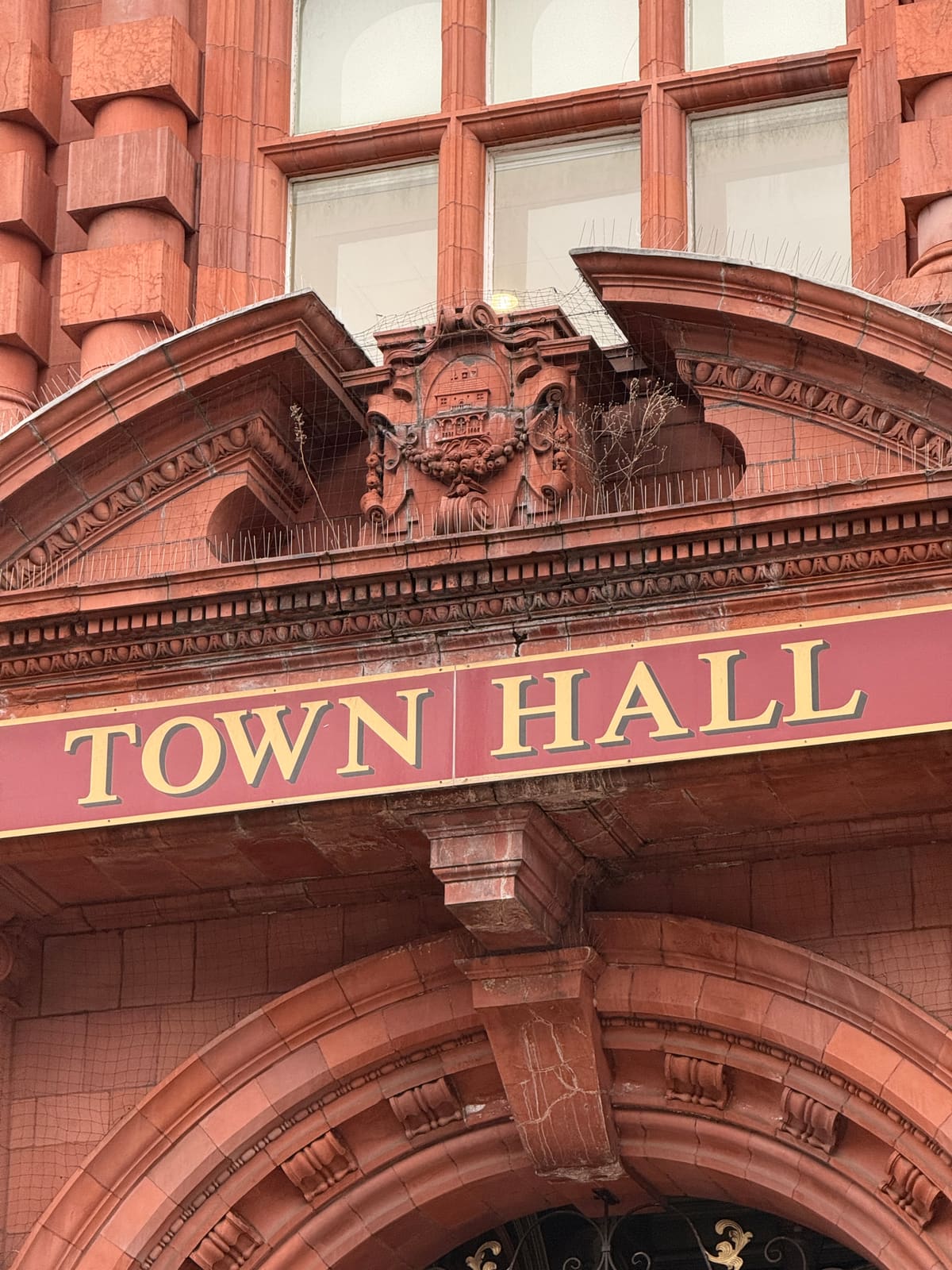
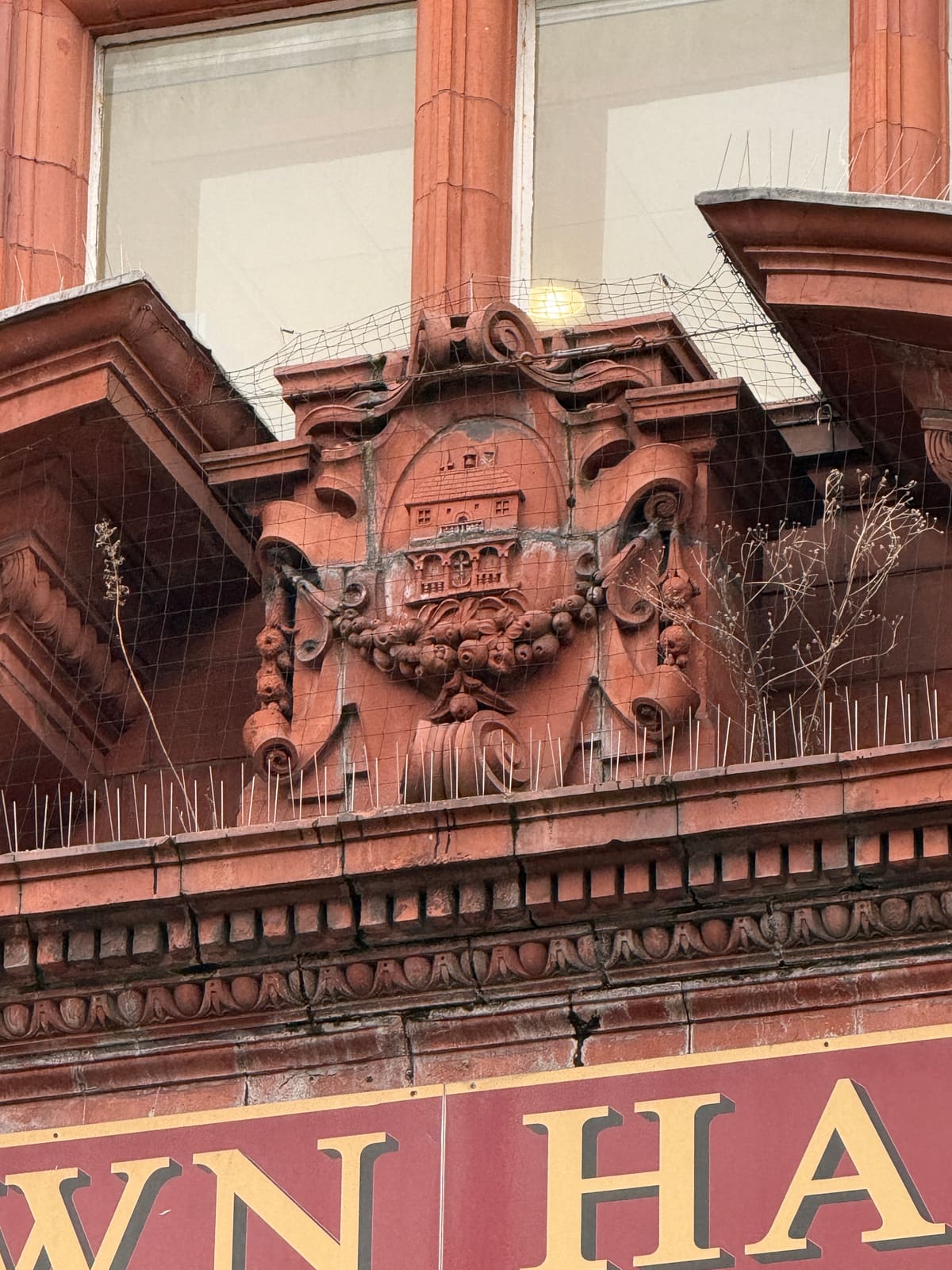
Now the material. Every single carved, moulded, ornamental bit of that facade isn't stone. It's terracotta — fired clay, pressed into moulds, baked in a kiln, and shipped in by the cartload. That warm, glowing red colour is the colour of the earth itself. Terracotta let Edwardian builders produce insanely intricate ornament at a price stone couldn't match — and when it's done this well, you honestly can't tell the difference. Every capital, every scroll, every fruit swag, every egg-and-dart moulding running under the cornices — all of it modelled by hand, fired, delivered, and set by terracotta fixers and bricklayers working at the absolute peak of their trade. No CAD. No CNC. Chisels, trowels, foremen with loud voices and no patience.
The 1928 carving on the gable
Now here's where it gets interesting. Up on one of those high gables there's a date 1928 carved into a cartouche with a letter M in a wreath. That date doesn't mark when the building was built — the main building is 1903. The 1928 is marking the extension.
Here's the story. By the mid-1920s the Mining Department was absolutely hammered — more students than they could fit, equipment piling up in corridors, teaching in spaces never meant for it. In 1926, the Miners Welfare Committee increased a provisional grant from £25,000 to £37,000 — specifically to let the college build a full four-storey extension. Plans were drawn up by the successor firm, Briggs and Thornely of Liverpool (same partnership, continued under a new name). The extension gave them space for an expanded Mining Department, a proper College Library, and extensions to the Physics and Engineering Departments. The Board of Education approved it in June 1926, the stone was carved 1928, and the extension opened in 1929.
So when you're stood there looking up — the main building is 1903, the extension is 1928/29 — twenty-five years apart, but blended so carefully that most people will never notice the join. That's proper architecture.
The college that ran the coalfield
The Wigan Mining and Technical College didn't appear out of nowhere. It grew out of the Wigan Mechanics Institute, founded in the 1850s — one of those Victorian self-improvement societies where working men went in the evenings to learn mathematics, engineering, drawing, whatever they needed to get on. By the turn of the century that little Institute had grown into what was regarded as one of the foremost mining engineering colleges in the entire country. Lads came from across Lancashire to train here. Men who went on to manage pits, design shafts, keep thousands of miners safe underground.
Think about that for a second. Every pit manager, every underground surveyor, every colliery engineer for miles around probably walked through those black double doors at some point in his career. This building was the industry.
Lux Ex Tenebris — "Light out of Darkness"
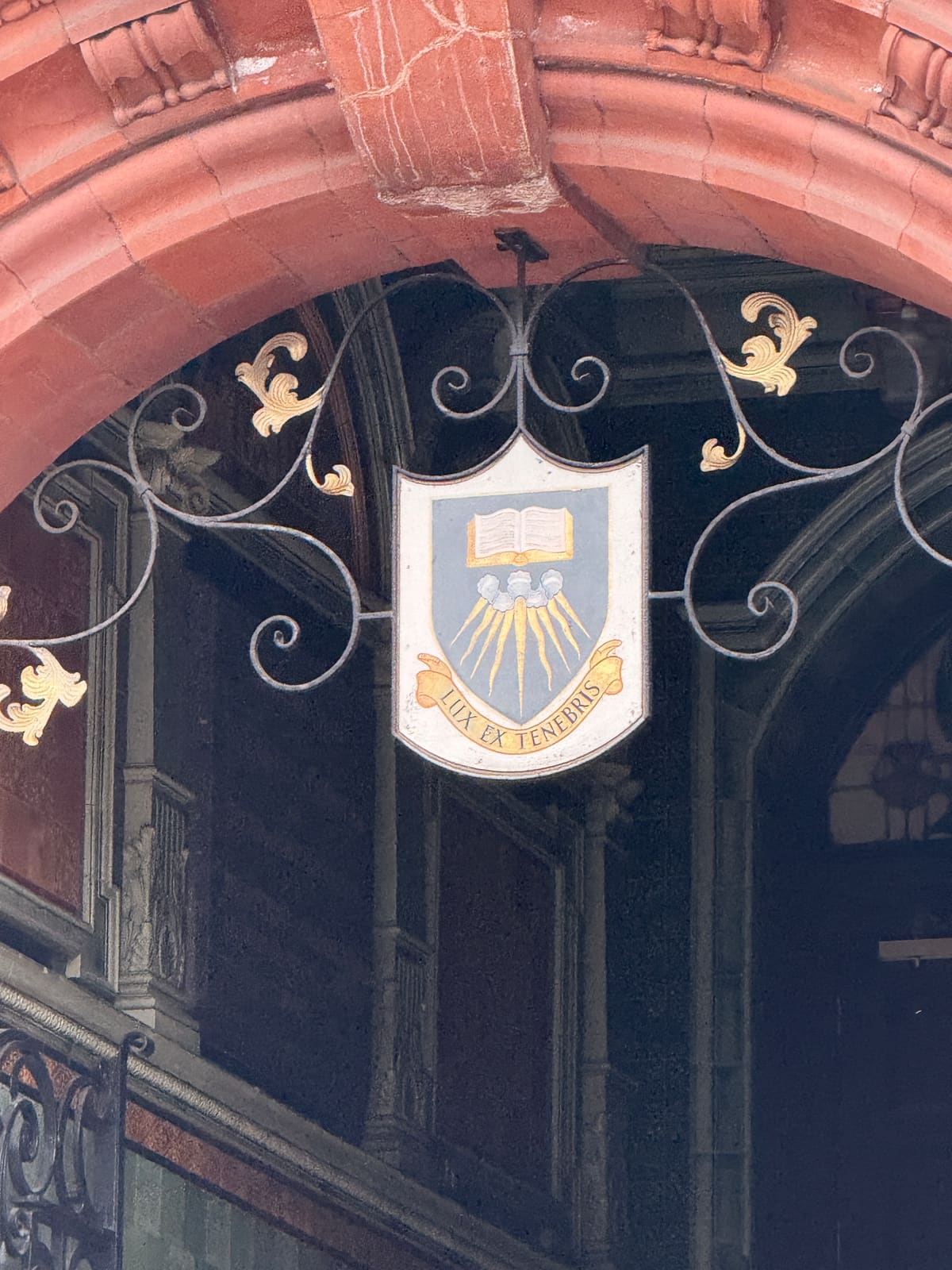
Walk up to the main entrance and look through the wrought-iron gate inside the archway. You'll see a painted shield with an open book at the top, rays of sunlight beaming down, and a banner underneath with two Latin words: "LUX EX TENEBRIS."
It means "Light out of Darkness."
Sit with that for a moment. Because you will never, in your whole life, find a more perfect motto for a mining college. The men who trained here were going down into the pitch-black seams a thousand feet under your feet — and the college above ground was the light. The knowledge. The science that kept them safe, the skill that made them better tradesmen than the lad in the next pit over. Light. Out of. Darkness.
That motto is still displayed above the main entrance today. It's still displayed inside the Council Chamber. Nobody has ever had the nerve to take it down, and long may that continue.
How the college became the Town Hall
As the pits declined through the mid-20th century, the college diversified — art, building, commerce, the lot. It was renamed Wigan College of Technology. By the late 1980s it had outgrown the building completely, and in 1990 it moved out to new premises on Walkden Avenue.
Meanwhile, over on King Street, Wigan's old Victorian Town Hall was falling apart. Ramshackle corridors, damp, not fit for purpose. The council looked up Library Street at this magnificent empty terracotta palace and thought: right, we'll have that. The building was converted, and on 25th November 1991, Diana, Princess of Wales officially opened the new Town Hall — unveiling a plaque, having lunch with civic leaders, the full works. That's how a mining college became the civic heart of a borough.
Then they nearly lost it
By the late 2000s, the terracotta had started to fail. Bits were breaking away from the facade — which is a genuinely serious problem, because once water gets in behind terracotta, it lifts off the structure and comes down in lumps. So in late 2008 an emergency round of repairs was carried out to secure the front.
Then between roughly 2014 and 2016, a full £7.2 million restoration was done by GT3 Architects with ISG Construction. They opened the interior up, stripped out dropped ceilings to reveal the original cornices hidden for decades, conserved the original floors, repaired the decorative tiling. And while they were pulling partitions down, the contractors stumbled across three things nobody knew were still there: a hidden network of tunnels thought to be part of the original heating system, an ornate mosaic floor, and an antique stained glass window — all boxed in and forgotten, waiting to be found.
Inside the Council Chamber, which was the old college Assembly Hall, there are still 22 original stained glass windows — every one of them carrying a quotation or proverb with a moral message for the students who sat beneath them. Imagine being a seventeen-year-old mining apprentice in 1905, sat in there for a lecture, staring up at a window telling you how to live your life. That's Edwardian Wigan for you.
Don't miss the bronzes in front
Before you move on, look at the bronze statues standing on the cobbles in front of the building. A man, a woman, a child — all dressed as colliery workers, all in traditional wooden clogs with iron-shod soles.
The man's a miner, cap on his head, safety lamp in his hand. The woman is what's called a Pit Brow Lass — the women who worked on the surface of the pit, picking stones out of the coal as it came up on the conveyor. The Mines and Collieries Act of 1842 had banned women and children from working underground, but the women of Wigan still worked the pits above ground in huge numbers, in all weathers, and they were a proper part of this industry.
The statue was sculpted by Steve Winterburn from Hull — the same man who did the Billy Boston statue nearby — and it was driven through by WHAMM, the Wigan Heritage and Mining Monument group, a charity founded by two local women, Anne Catterall and Sheila Ramsdale. They raised the money, they pushed it through, and they made sure that a town which had been the capital of the Lancashire coalfield finally had a proper memorial to the industry that built it.
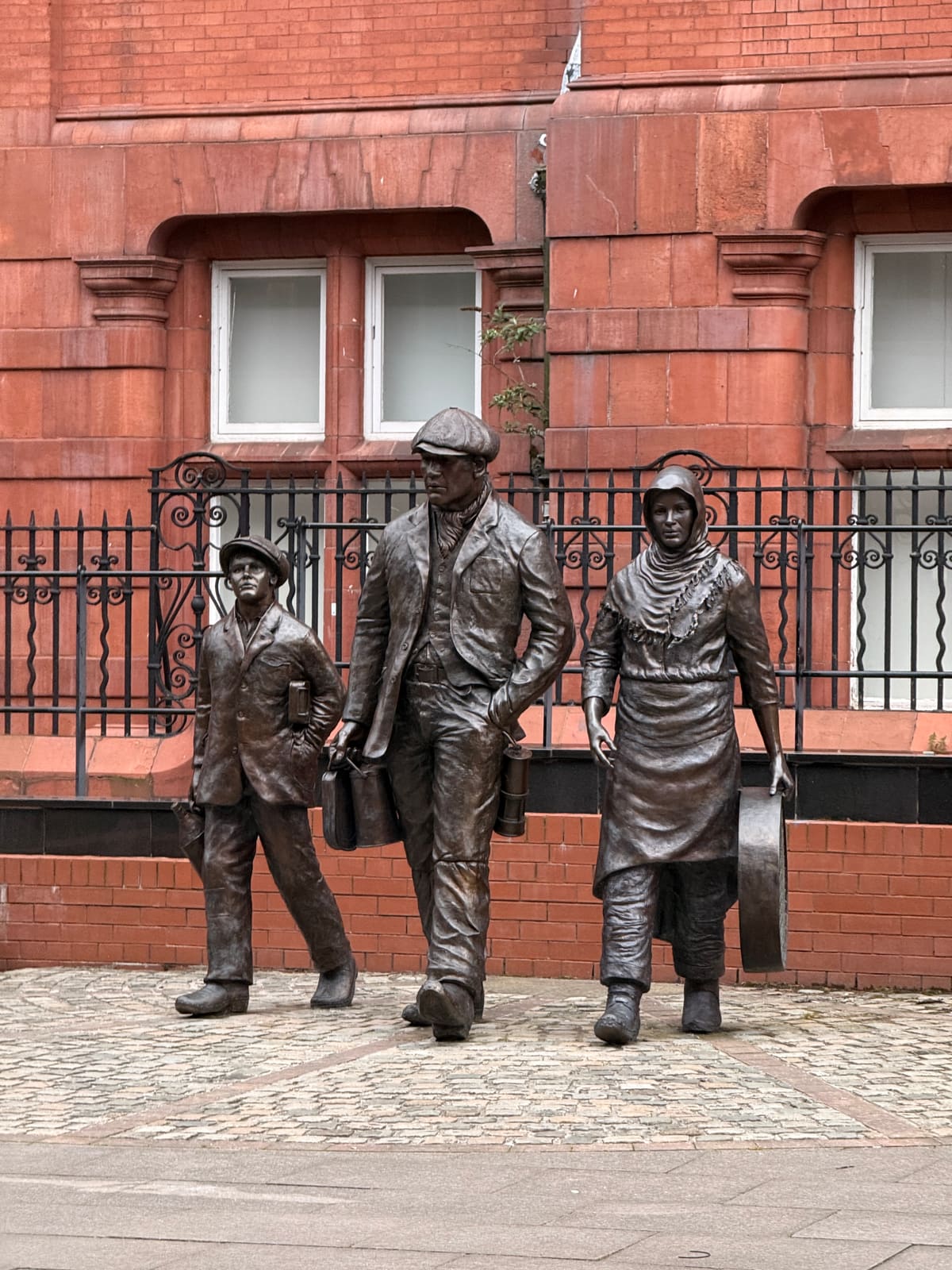
Notice — and this is the lovely detail — the figures have no plinth. They're not raised up on a pedestal looking down at you. They're stood on the cobbles, walking among us, at our level. Like they've just finished a shift and they're heading home. You could walk straight into them. That's not an accident. That's a sculptor who understood exactly who these people were.
Why this building matters
Here's the thing. Every scroll, every column, every swag of carved fruit, every egg-and-dart moulding on that building was modelled by hand in clay, fired in a kiln, shipped to site, and set by blokes with trowels and pointing irons who were operating at the absolute top of their trade. There's no computer design, no laser cutting, no 3D printing. Just drawings, skill, sweat, and generations of craft handed down from master to apprentice.
And it was all built for education. To train the lads of Wigan to go down the pit and come back up safer, smarter, and more skilled than their dads had been. Light out of darkness. You don't get a better reason to put up a building than that.
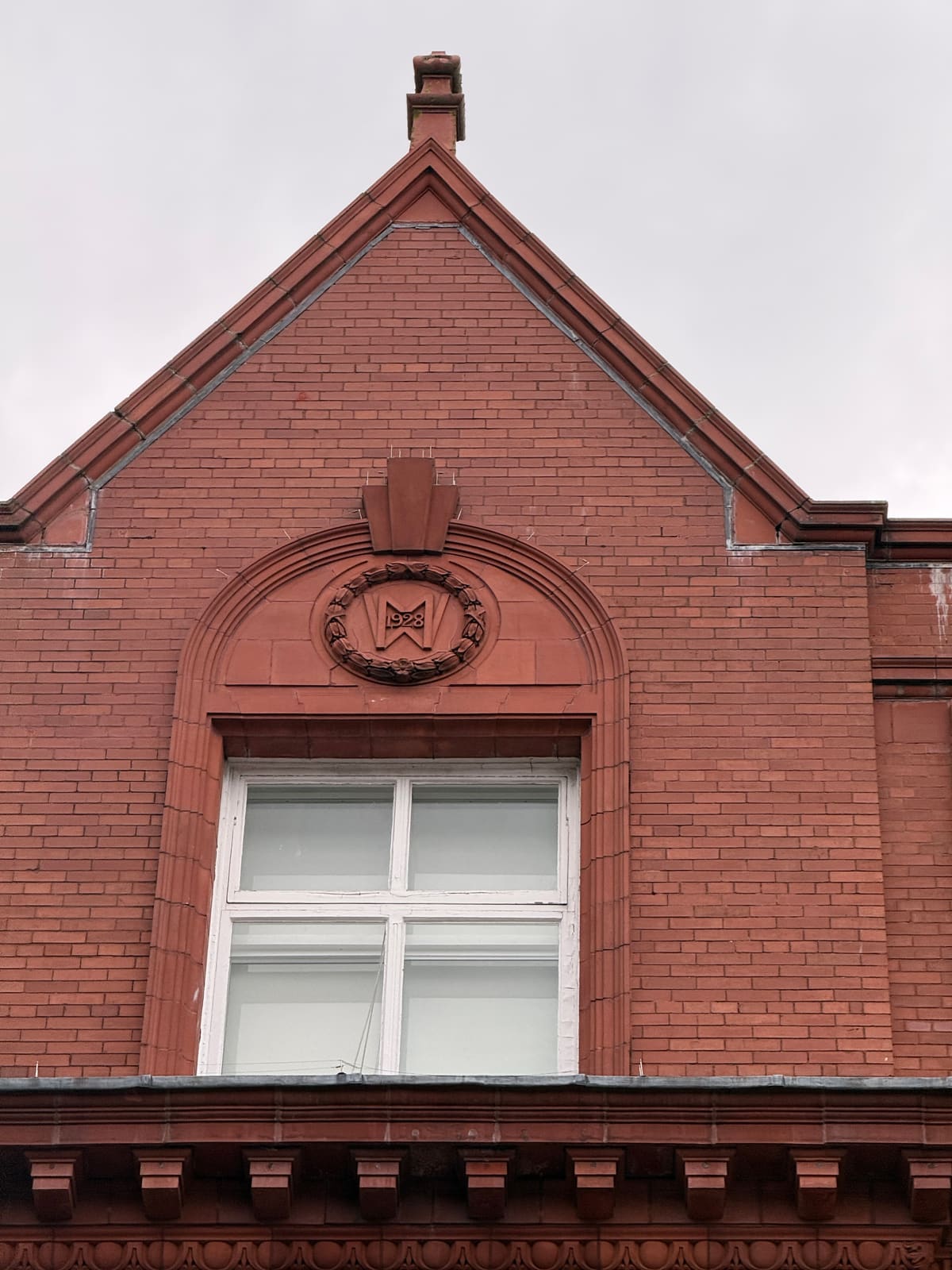
So next time you're walking up Library Street, stop. Look up. Count the cupolas. Find the 1928 on the gable. Read the Latin in the gate. Notice the craft.
Because this is what we used to build for each other, in this town, when we thought the people of Wigan deserved the best.
Go and look up
The old Mining & Technical College, Library Street, Wigan
There’s more in the app
- Listen to every story, read out
- Get told the day a new building goes up
- Tick off the ones you’ve stood in front of
- Suggest a building in your town
Got an old building of your own?
Old stone and old brick need a trade who knows how they were put up. Post the job free and trades near you see it straight away.