 Hard Hat Way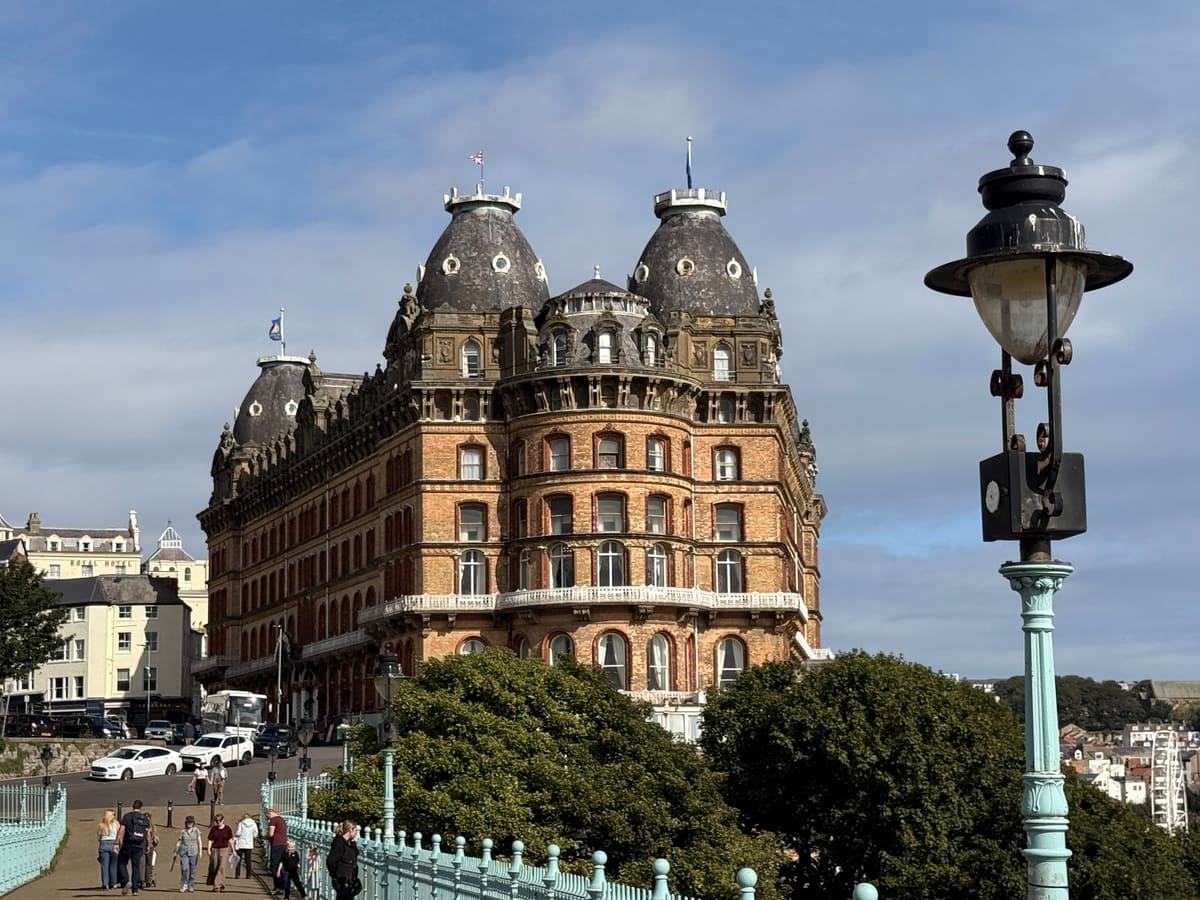
#LookUpHistory · Scarborough
Grand Hotel
If you’ve ever been to Scarborough, you’ve got a photo of the Grand Hotel. Everybody takes it from the Spa Bridge, green railings in the front, domes up against the sky. And somebody stood next to you will tell you the story: 365 rooms for the days of the year, 52 chimneys for the weeks, 12 floors for the months, four towers for the seasons. Lovely story. Hold onto it, because I went looking for it.
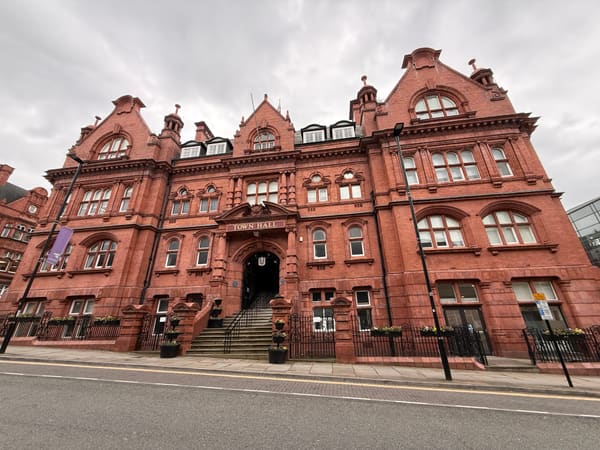
It stands on St Nicholas Cliff, and it was designed by Cuthbert Brodrick, a Hull lad who’d already given Leeds its Town Hall, the one Queen Victoria opened in 1858. The Grand opened on 24 July 1867, and it’s built straight into the side of the cliff. From the street it’s 112 feet high and eight storeys. Round the sea side it’s 160 feet and eleven storeys, dropping away towards the sands. When it opened, the papers called it one of the largest hotels in England, if not the largest.
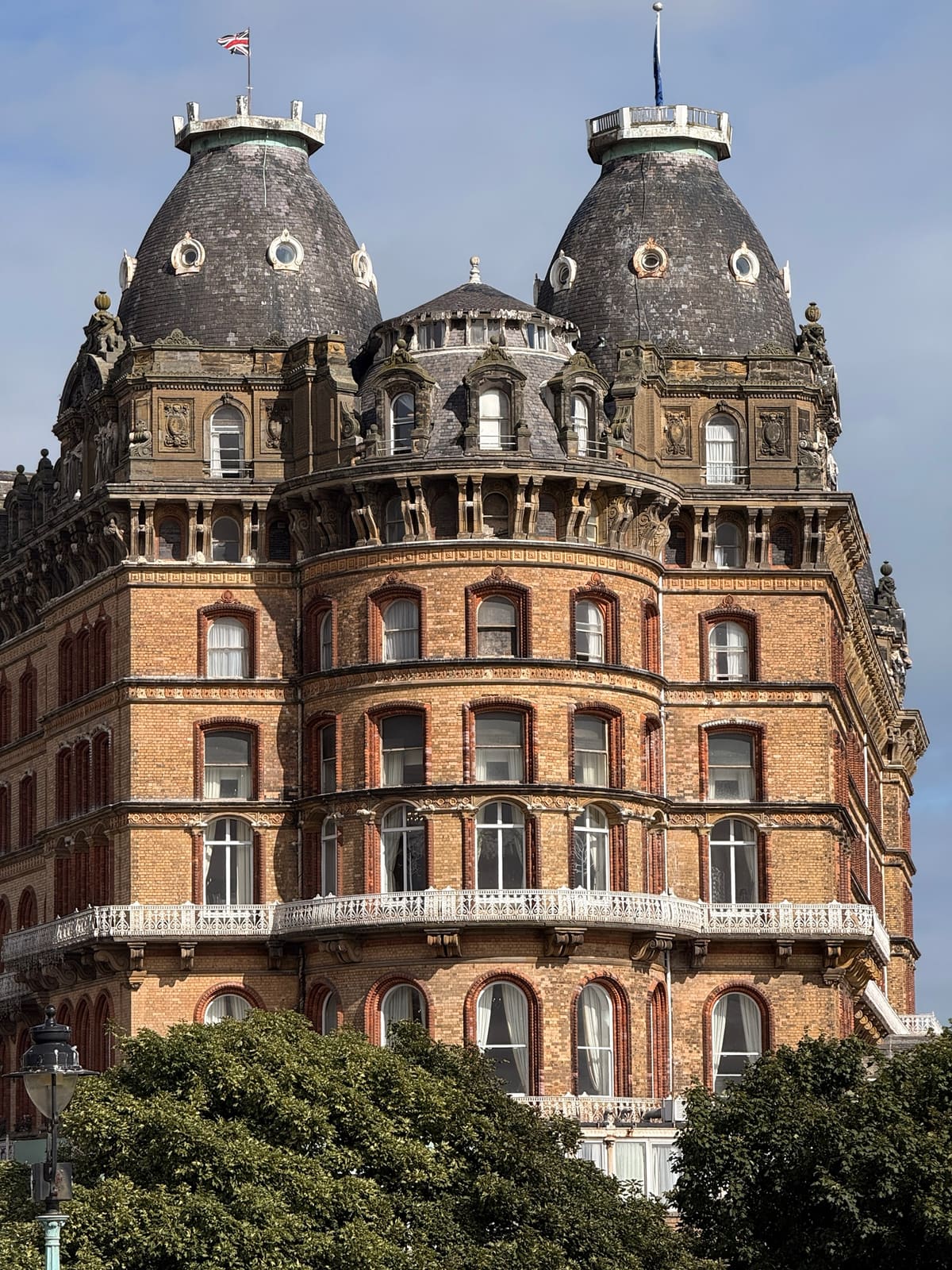
Now look at the colours. The walls are pale brick and every window is framed in red. That was the wrong way round for the time. In 1867 the trade paper Building News pointed out that hotels were normally red brick trimmed with white, and said this one wore a bandsman’s uniform, white faced with red. They didn’t mean it kindly. Stand on that bridge on a sunny afternoon and I reckon Brodrick won that argument.
About six million bricks went into it. That’s the figure reported the week it opened. Six million, every one of them picked up by hand, buttered by hand and laid to a line. Even at a thousand a day, which is a good day for one man on plain wall, that’s six thousand days of bricklaying. And not much of this wall is plain.
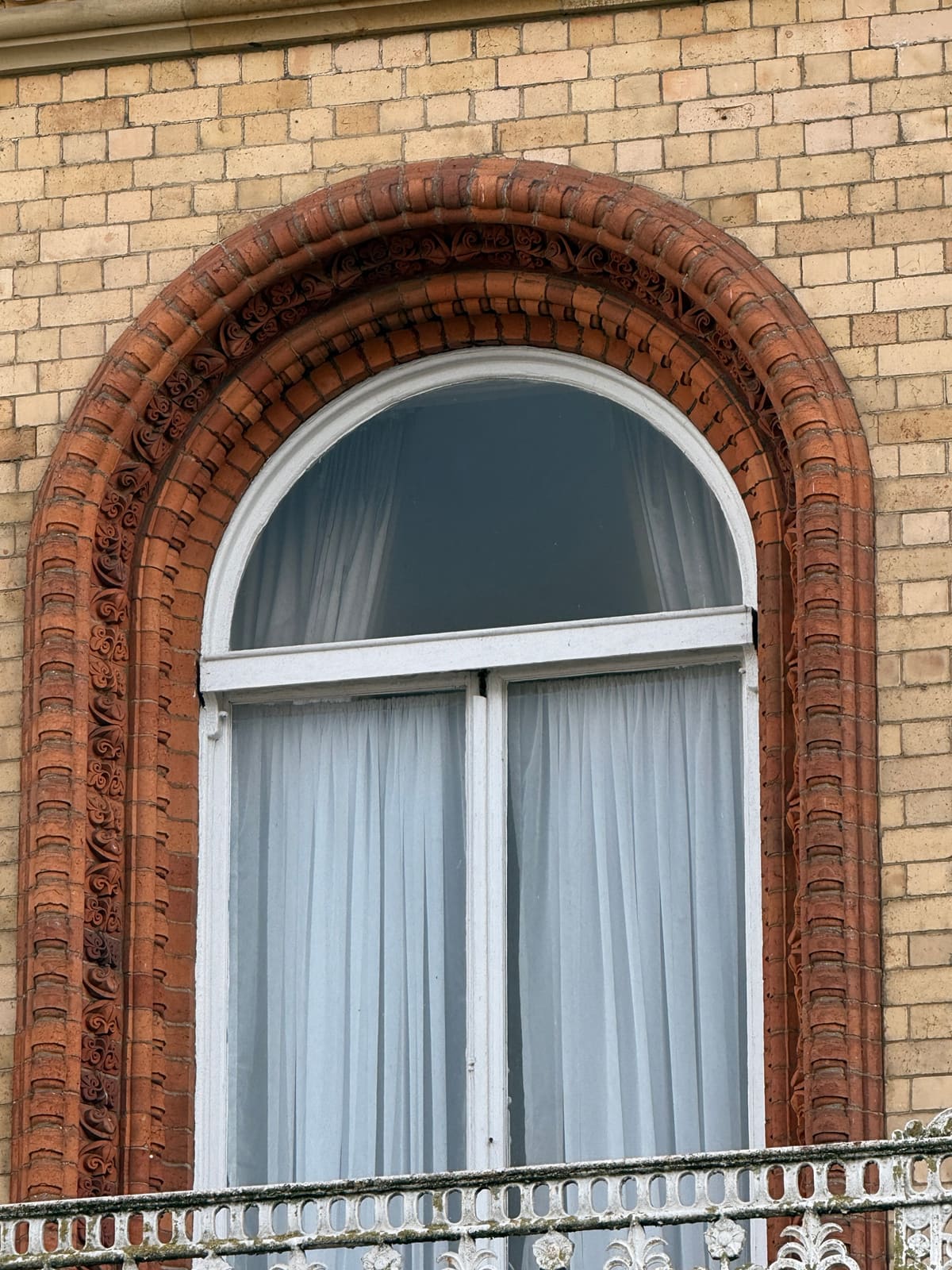
Get close to one of the windows, because this is my favourite bit. Look at the wall first. It’s English bond: a course of headers, the short ends, then a course of stretchers, the long faces, all the way up. It’s the strongest bond there is and the slowest to lay. Then look at the arch. Those red bricks weren’t cut on site. The 1867 report calls them cast bricks “of an unusually ornamental character”, made in moulds to the exact shape. Ring after ring of them, with a band of scrolled leaves running through the middle, every one set round a timber frame to hold the curve until the mortar went off. Look how even those joints stay all the way round the bend. Anyone who’s turned an arch will tell you that’s not easy.
Here’s something most people walking past have no idea about. This building went bust halfway up. The Scarborough Cliff Hotel Company was set up in 1862 and cleared the cliff top the following spring. In October 1863 nine firms bid for the job and a bid of £66,000 won it. Then the money ran out. Thousands of shares never sold. Three shareholders took the company to court and won, in a case that ended up in the law books. The contractor never finished. In September 1865 the half-built hotel was sold off for just over £43,000.
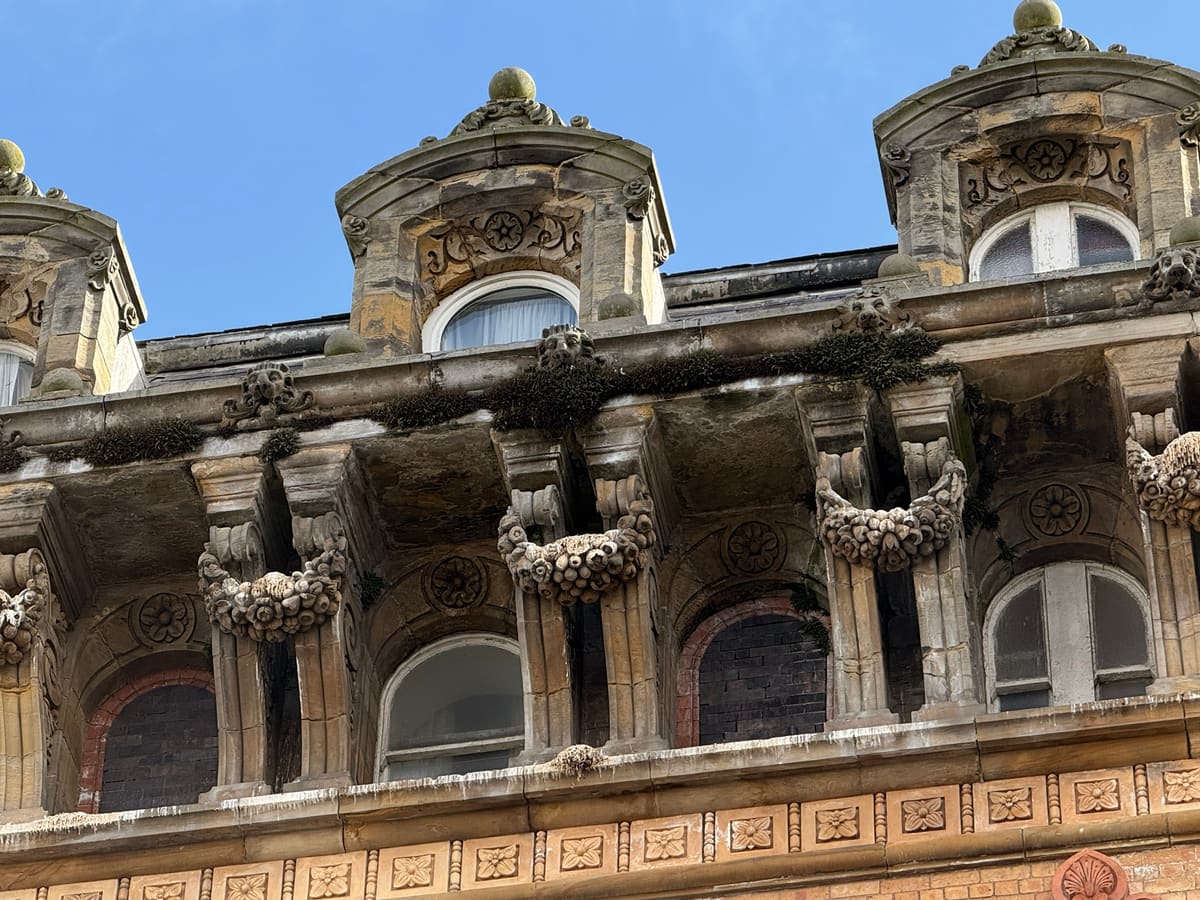
When work started again in January 1866, the walls had only reached the main cornice. Everything above that point went up in the next eighteen months: two more storeys, the carved dormers and all four domes. The man who finished it was Archibald Neill of Bradford, who ran the biggest building firm in that town, with around a thousand men and his own quarries. The job was late and over budget before he’d laid a brick, and they still did the top of it like this.
Look along that roofline. Just under it runs a band of little square panels, each with a four-petal flower, split up by rows of beads. That’s terracotta, clay pressed into a mould and fired in a kiln like a brick, and in the 1860s it was only just coming back into fashion. Above it, big stone brackets hold up the eaves, with a lion’s head on the ledge between them and a heavy garland of fruit and flowers slung between every pair.
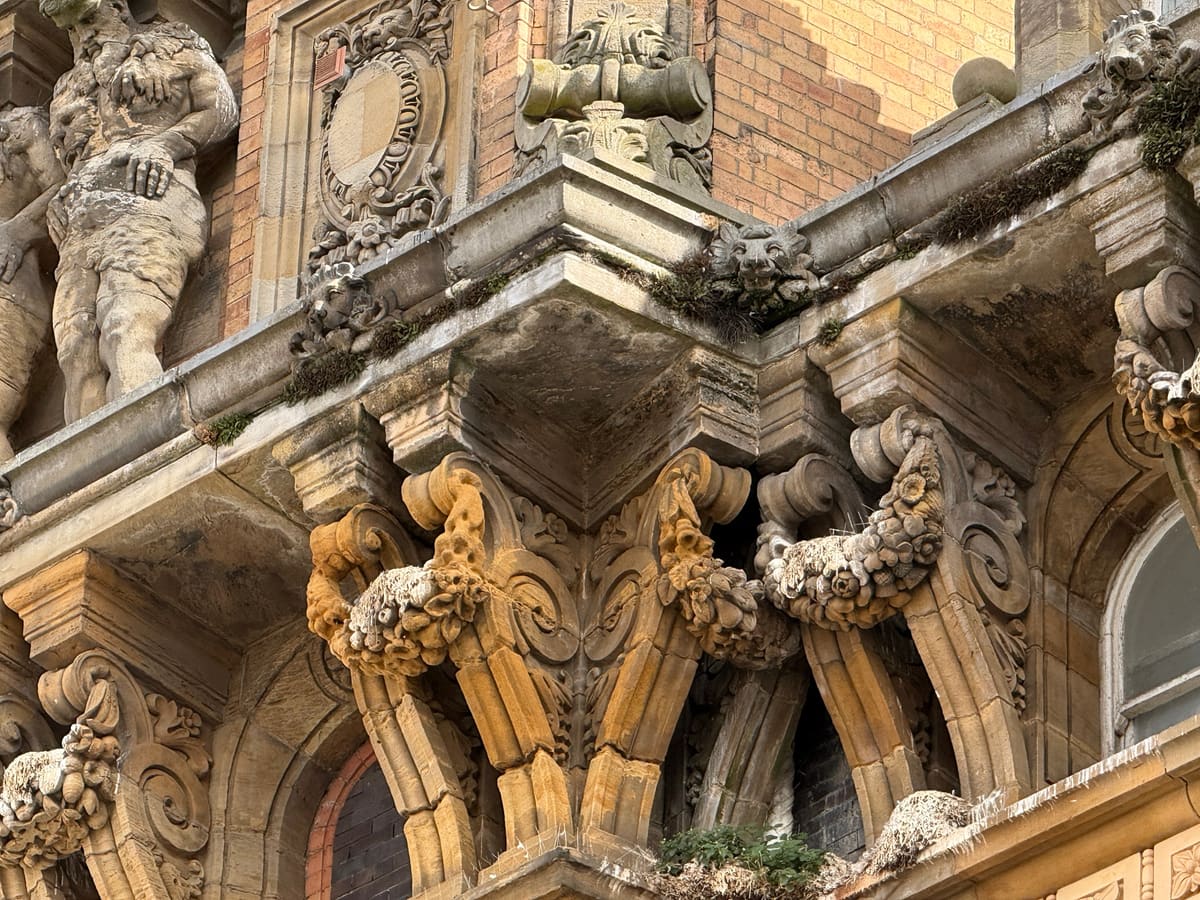
Get your eye right up to one of those brackets. It isn’t one stone. It’s built up out of blocks, stacked like a column, and the fluting, those long grooves, lines up across every joint. Somebody carved each block separately on the ground and had to trust it would meet the next one perfectly, right up at the top of the building. Then see where the stone has gone orange and full of holes, like a sponge. That’s the sea. Salt spray soaks into sandstone, dries out, grows crystals and pushes the grains apart, a little at a time, for a hundred and fifty years. It’s called honeycomb weathering. The white fuzz on the garlands is bird spikes and droppings.
Now look up at the domes. They went up in that same 1866 to 1867 push, and each one held three bedrooms for the servants. Not everybody liked them. That same 1867 critic called them “four roc’s eggs”, after the giant bird in Aladdin, each with its own little incubator on top, and said he wished they could hatch a dividend. Harsh, but he had a point about the dividend. In the Second World War, when the RAF had the hotel, they’re said to have put anti-aircraft guns up there.
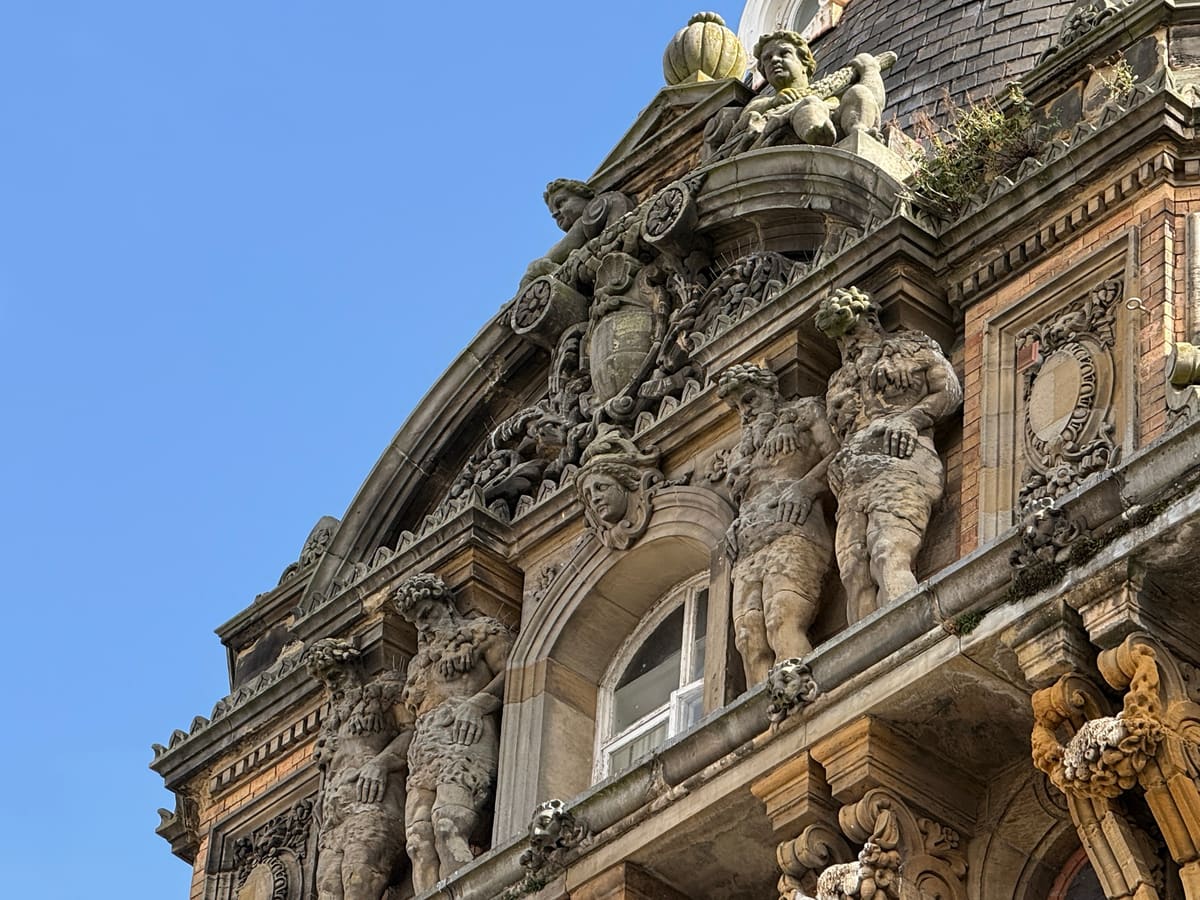
Under the domes, on the faces of the towers, stand the giants. Four of them round each window. Big bearded lads with their hair full of fruit. The proper name is atlantes, men carved to look like they’re holding the building up. Look at what they’re wearing: lion skins. That’s Hercules’s outfit, the strongest man in the old stories. Derek Linstrum, who wrote the book on Brodrick, traced them back to the New Louvre in Paris, just finished for Napoleon III. Scarborough was getting a bit of Paris.
Above them sits a curved pediment with two cherubs lounging on it, one hugging what looks like a horn of plenty, and in the middle a shield with nothing on it. No crest, no initials. It looks like it was made to carry something, and I can’t find anyone who ever recorded what. The carving is said to be the work of Burstall and Taylor, carvers from Cookridge Street in Leeds, though only one old newspaper piece says so. If it was them, they never got their names on it either.
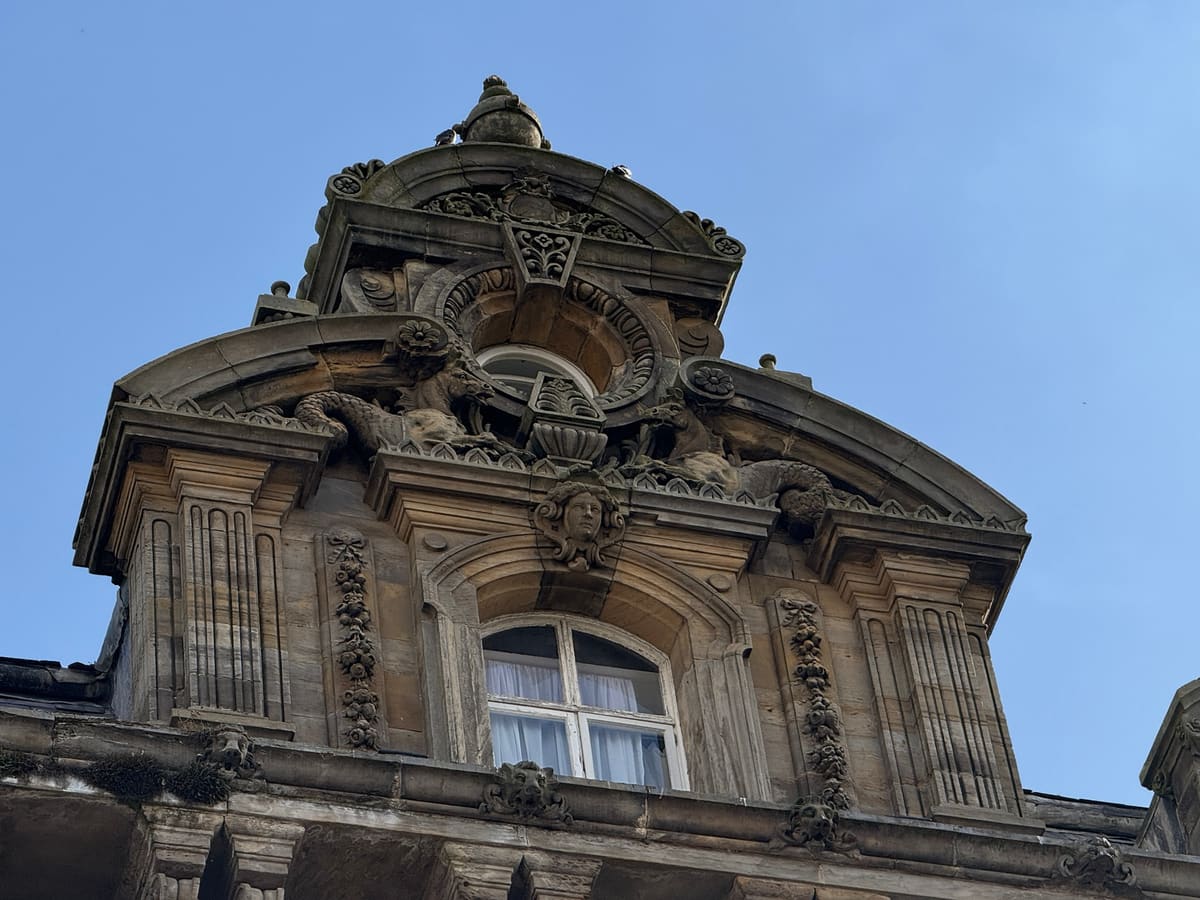
Round the side there’s a tall stone dormer that tells you exactly where you are. Either side of the round window lies a sea creature with a horse’s head and a long coiled fish’s tail. They look like hippocamps, the sea-horses that pulled Neptune’s chariot. A scallop shell sits between them, strings of carved flowers hang down either side, and below it all a woman’s face looks out from the keystone. The building faces the sea, and the carvers made sure you’d know it.
So, the calendar. The trade papers that wrote this building up in 1866 and 1867 give you 300 bedrooms planned and about 350 rooms when it opened, and not one of them mentions a calendar. It looks like a story that grew up later. There are seasons on this building, though, if you look. Round the sea end the carvers put four women said to stand for the four seasons, because the company’s pitch was that Scarborough was worth a visit all year round. The only seasons carved into the Grand are a sales pitch in stone. I like that better anyway.
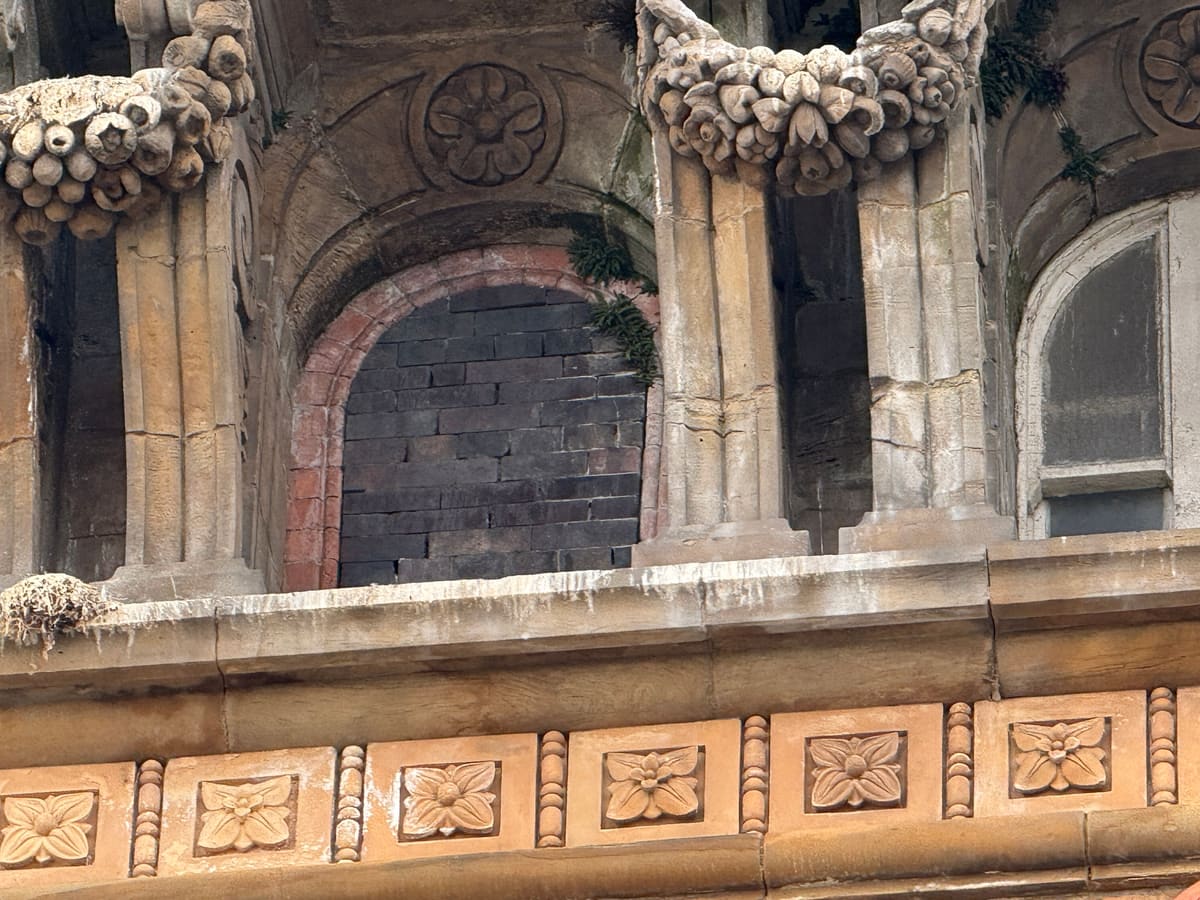
Now the one every bricklayer will spot. Along the top floor, some of the arches behind the brackets have been filled in with dark brick. Somebody will always tell you that’s the window tax. It isn’t. The window tax was scrapped in 1851, twelve years before the first brick went in here. So why were they filled? I couldn’t find a record. The infill is a different brick altogether, and there’s a fern growing out of the joints. Every building keeps a few secrets.
And look at the band just under it. That terracotta flower band is still crisp, every petal, after a hundred and fifty years of salt air. The stone ledge right above it has cracked through and has weeds growing out of it. Fired clay stands up to the sea better than softer stone does, and this building shows you both, a few inches apart.
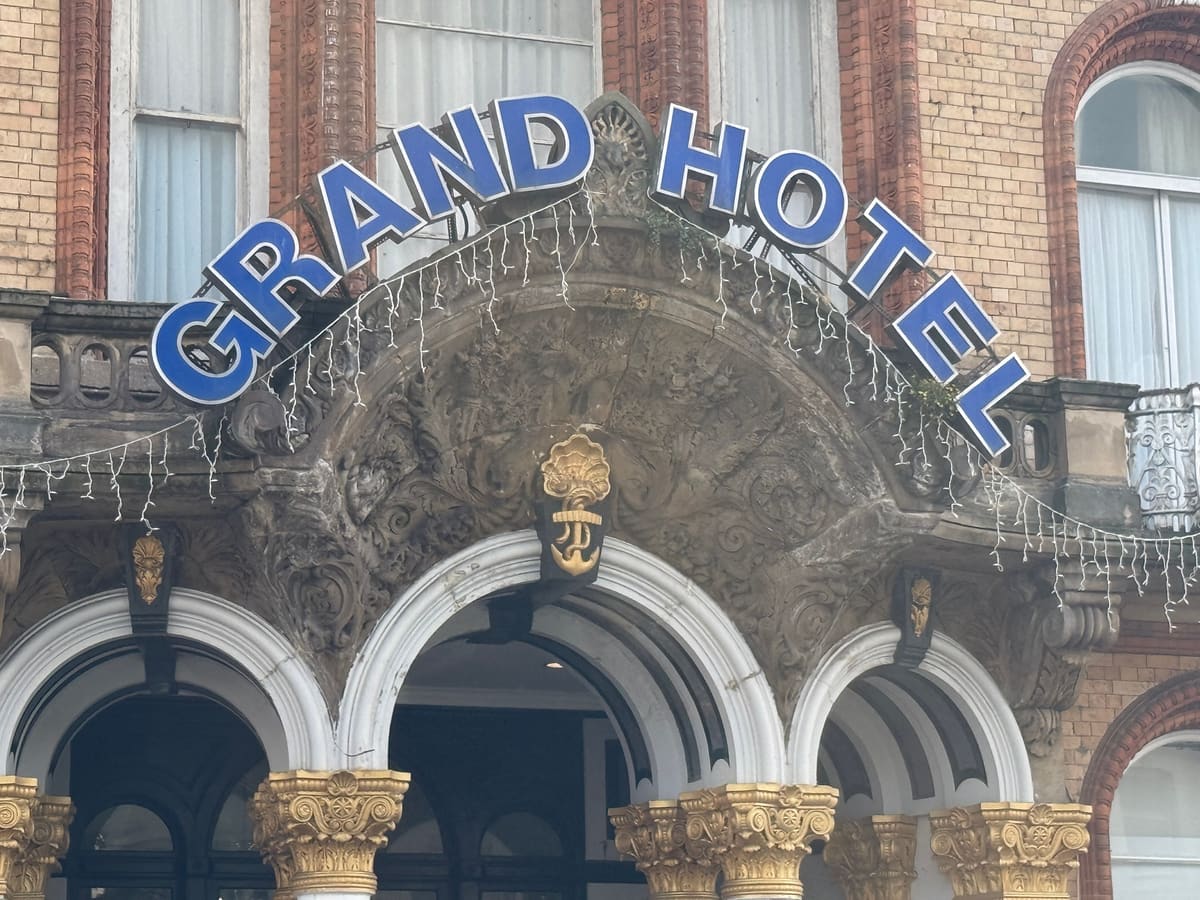
Down at street level, the main entrance has a stone canopy thick with carved leaves and scrolls. It’s taken a battering and the detail has worn soft. In the middle, over the arch, there’s a gilded scallop shell above an anchor with a rope wound round it. Sailors call that a fouled anchor. I can’t find anyone who wrote down when it went up or why. An anchor has stood for hope and a safe harbour for centuries, which isn’t a bad sign to hang over a hotel door.
Just left of the door there’s a blue plaque. Anne Brontë, the youngest of the Brontë sisters, came to Scarborough for the sea air in May 1849 and died three days after she arrived, on 28 May, in lodgings that stood on this spot. In March 1863 the houses along this bit of cliff were pulled down to make room for the hotel. The company auctioned off all the building materials, timber and everything else, except the bricks. They kept those. Whether any of them went back into these walls, nobody wrote down.
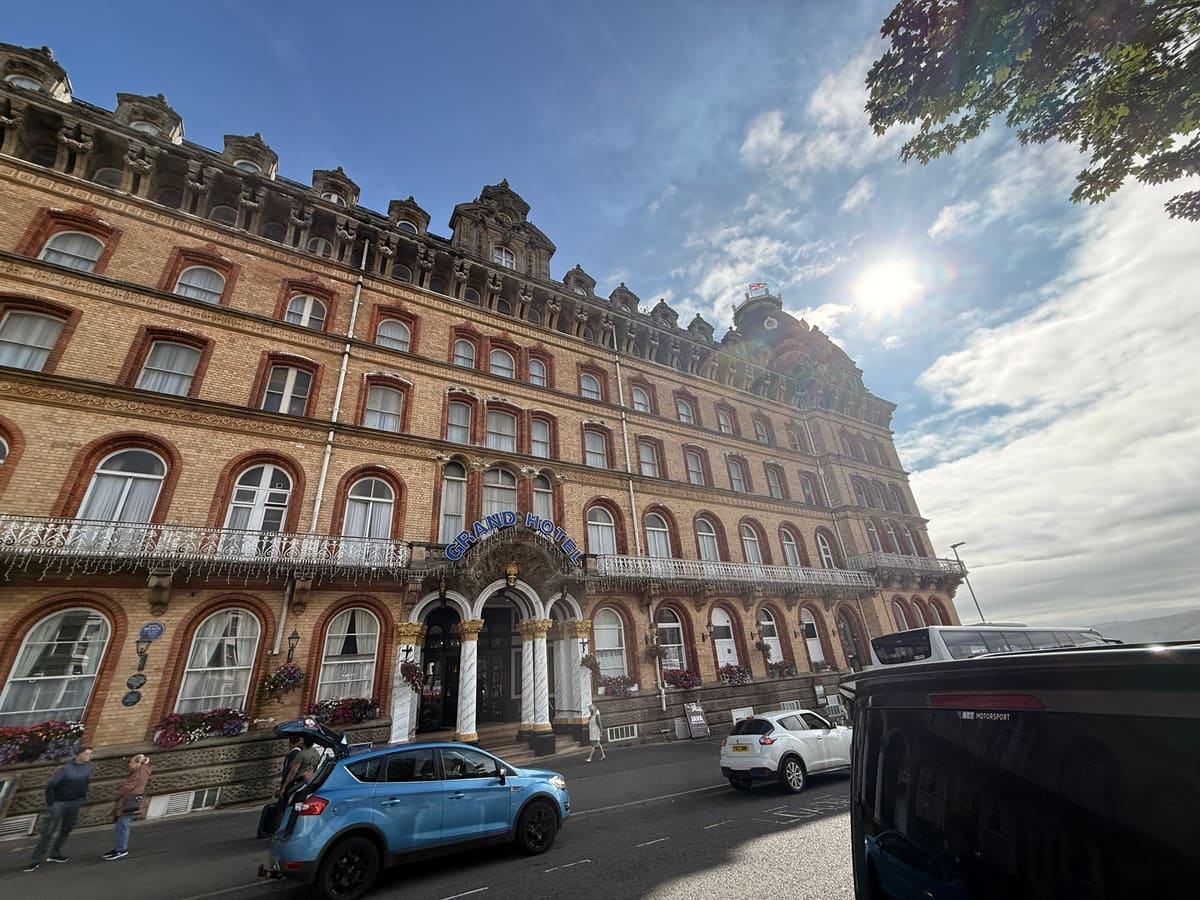
This building has had a life. On 16 December 1914 two German battlecruisers, the Derfflinger and the Von der Tann, shelled the town from the bay, and the Grand took more than thirty hits. In the Second World War it trained RAF aircrew. These days the kittiwakes nest on its ledges in their hundreds, and salt, gulls and weather have a go at the stone every single day. Moss on the cornices, ferns in the joints, cracks in the ledges. And still six million bricks standing on the side of a cliff, laid by men nobody wrote down, who carved giants and sea-horses for a skyline almost nobody looks at properly. They did it right anyway. Pride and quality, all six million of them.
Look up.
Go and look up
Grand Hotel, Scarborough
There’s more in the app
- Listen to every story, read out
- Get told the day a new building goes up
- Tick off the ones you’ve stood in front of
- Suggest a building in your town
Got an old building of your own?
Old stone and old brick need a trade who knows how they were put up. Post the job free and trades near you see it straight away.